

Make a donation
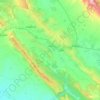
Umm al Binni lake topographic map
Click on the map to display elevation.
Make a donation
Umm al Binni lake
Based on the interpretation of satellite imagery, Sharad Master suggests the 3.4 km (2.1 mi) in diameter dry lake may be an impact crater based on its nearly circular, slightly polygonal rim shape, and contrasting shape to other lakes in the region. However, the circularity of its shape has been disputed, with a 2018 study finding that the northeastern and southwestern sections of the lake rim were straight, corresponding to the directions of regional faulting. As to its origin, Masters rejects karst topography, salt doming, tectonic deformation, and igneous intrusion as well as possible bombing or man-made origins. However, a 2018 study concluded that the formation of the lake could be better explained by the subsidence of the underlying basement fault blocks, and that the southern part of the rim had been anthropogenically shaped.
Make a donation
About this map

Name: Umm al Binni lake topographic map, elevation, terrain.
Average elevation: 2 m
Minimum elevation: 1 m
Maximum elevation: 4 m
Make a donation
Other topographic maps
Click on a map to view its topography, its elevation and its terrain.
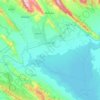
Al-Faw
Another view suggests that the name is derived from the city’s position at the mouth (fāh) of the Shatt al-Arab, which evolved linguistically into Faw. Some sources, however, argue that the original word was al-Faʾu (الفأو), meaning “open land visible to the eye” or “land enclosed between two elevations”.
Average elevation: 1 m
Al-Faw
Another view suggests that the name is derived from the city’s position at the mouth (fāh) of the Shatt al-Arab, which evolved linguistically into Faw. Some sources, however, argue that the original word was al-Faʾu (الفأو), meaning “open land visible to the eye” or “land enclosed between two elevations”.
Average elevation: 1 m
Make a donation


Make a donation


Make a donation



Make a donation


Make a donation


Make a donation


Make a donation


Make a donation

Make a donation


Al-Anbar Governorate
Anbar is one of the driest governorates in Iraq's western desert climate. Some of Al Anbar is part of the Syrian Desert, characterized by steppe and desert terrain. Most of Al Anbar is considered as a topographical continuation of the Arabian Peninsula plateau region. It has some small hills and a number of…
Average elevation: 399 m

Darbandikhan Dam
The dam is located within a gorge on a foundation of sedimentary rocks. It is a rock-fill embankment type with a central clay core. The dam is 128 m (420 ft) tall and 445 m (1,460 ft) long (535 m (1,755 ft) if the spillway section is included). Its crest is 17 m (56 ft) wide and at an elevation of 495 m (1,624…
Average elevation: 571 m
Make a donation


Make a donation


Make a donation
Make a donation

Make a donation

Halabja
Iraq > Halabja Governorate > Halabja District
Halabja is located in the Shahrizor plain, a fertile valley nestled in the foothills of the Zagros Mountains in the Kurdistan Region of Iraq. The city's elevation is around 700 meters above sea level. The surrounding area is characterized by mountainous terrain, with the Hawraman Mountain range to the east,…
Average elevation: 901 m


Make a donation


Make a donation
Make a donation


Make a donation

Make a donation


Make a donation


Al-Anbar Governorate
Anbar is one of the driest governorates in Iraq's western desert climate. Some of Al Anbar is part of the Syrian Desert, characterized by steppe and desert terrain. Most of Al Anbar is considered as a topographical continuation of the Arabian Peninsula plateau region. It has some small hills and a number of…
Average elevation: 399 m

Make a donation


Make a donation


Make a donation


Ranya
Iraq > Sulaymaniyah Governorate
Ranya is located in the Sulaymaniyah Governorate in the Kurdistan Region of Iraq, approximately 70 km northeast of Sulaymaniyah city. It is situated near the Hawraman Mountains and lies at an altitude of about 1,300 meters.
Average elevation: 678 m

Make a donation



Make a donation