

Make a donation
Osaka Prefecture topographic map
Click on the map to display elevation.
Make a donation
About this map
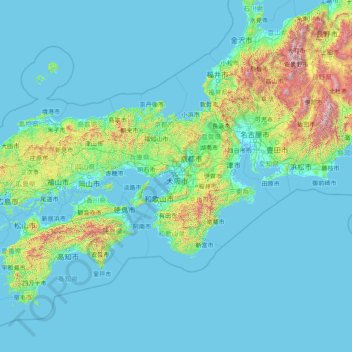
Name: Osaka Prefecture topographic map, elevation, terrain.
Location: Osaka Prefecture, Japan (32.01988 132.89036 37.21988 138.09036)
Average elevation: 188 m
Minimum elevation: -5 m
Maximum elevation: 3,053 m
Make a donation
Other topographic maps
Click on a map to view its topography, its elevation and its terrain.
Tokyo
The mainland portion of Tokyo lies northwest of Tokyo Bay and measures about 90 km (56 mi) east to west and 25 km (16 mi) north to south. The average elevation in Tokyo is 40 m (131 ft). Chiba Prefecture borders it to the east, Yamanashi to the west, Kanagawa to the south, and Saitama to the north. Mainland…
Average elevation: 22 m
Hakone
Hakone is characterized by its rugged topography, featuring a mix of mountainous terrain, valleys, and volcanic landscapes. Nestled within the greater Fuji-Hakone-Izu National Park, Hakone's elevation varies dramatically, with peaks rising over 4,000 feet and low-lying areas near Lake Ashi, which sits at…
Average elevation: 722 m
Yokohama
Yokohama has a total area of 437.38 km2 (168.87 sq mi) at an elevation of 5 metres (16 ft) above sea level. It is the capital of Kanagawa Prefecture, bordered to the east by Tokyo Bay and located in the middle of the Kantō plain. The city is surrounded by hills and the characteristic mountain system of the…
Average elevation: 23 m
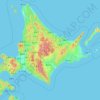
Hokkaido
As Japan's coldest region, Hokkaidō has relatively cool summers and icy/snowy winters. Most of the island falls in the humid continental climate zone with Köppen climate classification Dfb (hemiboreal) in most areas but Dfa (hot summer humid continental) in some inland lowlands. The average August…
Average elevation: 98 m
Make a donation
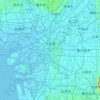
Tokyo
The mainland portion of Tokyo lies northwest of Tokyo Bay and measures about 90 km (56 mi) east to west and 25 km (16 mi) north to south. The average elevation in Tokyo is 40 m (131 ft). Chiba Prefecture borders it to the east, Yamanashi to the west, Kanagawa to the south, and Saitama to the north. Mainland…
Average elevation: 22 m

Make a donation
Kamakura
The Kamakura shogunate era is called by historians the Kamakura period and, although its end is clearly set (Siege of Kamakura (1333)), its beginning is not. Different historians put Kamakura's beginning at a different point in time within a range that goes from the establishment of Yoritomo's first military…
Average elevation: 33 m

Tokyo Bay
The shoal between Cape Futtsu in Chiba Prefecture and Cape Honmaku in Yokohama is known as Nakanose, and has a depth of 20 m (66 ft). North of this area the bay has a depth of 40 m (130 ft) and an uncomplicated underwater topography. Areas south of Nakanose are significantly deeper moving towards the Pacific…
Average elevation: 19 m
Make a donation

Make a donation


Nagano
Nagano (長野市, Nagano-shi, pronounced [nagaꜜno ɕi]) is the capital and largest city of Nagano Prefecture, located in the Nagano Basin (Zenkoji Daira) in the central Chūbu region of Japan. Nagano is categorized as a core city of Japan. Nagano City is the highest prefectural capital in Japan, with an…
Average elevation: 828 m
Make a donation

Kawanehon
Kawanehon is located in north-central Shizuoka, along the upper reaches of the Ōi River, with approximately 90% of the town area covered in forest and mountains. It is bordered to the north by the Japanese Alps, with peaks ranging to 2400 meters. Forests range from Siebold's Beech at lower elevations to…
Average elevation: 914 m

Make a donation


Sapporo
Sapporo is a city located in the southwest part of Ishikari Plain and the alluvial fan of the Toyohira River, a tributary stream of the Ishikari River. It is part of Ishikari Subprefecture. Roadways in the urban district are laid to make a grid plan. The western and southern parts of Sapporo are occupied by a…
Average elevation: 273 m
Okinawa Island
The Motobu Peninsula in the north has limestone layers and karst development. In the center and south is mainly a Ryukyu limestone layer and mudstone. The topography is flat, there are few hills over 100 m (328 ft) with very few rivers. The subtropical rains accelerate erosion so there are many drainages and…
Average elevation: 14 m
Make a donation

Takayama
Takayama (高山市, Takayama-shi) is a city located in Gifu Prefecture, Japan. As of 1 January 2019, the city had an estimated population of 88,473 in 35,644 households, and a population density of 41 persons per km2. The total area of the city was 2,177.61 square kilometres (840.78 sq mi) making it the…
Average elevation: 1,157 m


Make a donation


Make a donation


Shinjuku
Naturally, most of Shinjuku is occupied by the Yodobashi Plateau, the most elevated portion of which extends through most of the Shinjuku Station area. The Kanda River runs through the Ochiai and Totsuka areas near sea level, but the Toshima Plateau also builds elevation in the northern extremities of Totsuka…
Average elevation: 35 m

Higashidori
Higashidōri occupies the northeastern coastline of Shimokita Peninsula, facing the Pacific Ocean to the east and Tsugaru Strait to the north, with Cape Shiriya forming a boundary between the two waters. The low Shimokita Hills run north–south through the center of the village. Mount Kuwabata, the highest…
Average elevation: 45 m
Make a donation

Sendai
Sendai is located at lat. 38°16'05" north, long. 140°52'11" east. The city's area is 788.09 km2 (304.28 sq mi), and stretches from the Pacific Ocean to the Ōu Mountains, which are the east and west borders of Miyagi Prefecture. As a result, the city's geography is quite diverse. Eastern Sendai is a plains…
Average elevation: 185 m
Nagasaki
On the day of the nuclear strike (August 9, 1945) the population in Nagasaki was estimated to be 263,000, which consisted of 240,000 Japanese residents, 10,000 Korean residents, 2,500 conscripted Korean workers, 9,000 Japanese soldiers, 600 conscripted Chinese workers, and 400 Allied POWs. That day, the Boeing…
Average elevation: 44 m

Make a donation

Make a donation

Kitakami
Kitakami is located in south-central Iwate Prefecture, in the Kitakami River valley, approximately 45 kilometers south of the prefectural capital of Morioka, and 490 kilometers north of Tokyo. The city is at the confluence of the Kitakami River and the Waga River and has an altitude ranging from 50 to 200…
Average elevation: 233 m


Make a donation


Make a donation

Takasaki
Takasaki is located in the southwestern part of Gunma Prefecture in the flat northwestern part of the Kantō Plain. The city is located approximately 90 to 100 kilometers from central Tokyo. Mount Akagi, Mount Haruna and Mount Myogi can be seen from the city, and the southern slopes of Mount Haruna are within…
Average elevation: 331 m


Make a donation

Make a donation


Tokyo
The mainland portion of Tokyo lies northwest of Tokyo Bay and measures about 90 km (56 mi) east to west and 25 km (16 mi) north to south. The average elevation in Tokyo is 40 m (131 ft). Chiba Prefecture borders it to the east, Yamanashi to the west, Kanagawa to the south, and Saitama to the north. Mainland…
Average elevation: 22 m
Make a donation


Fuchu
Fuchū is located about 20 km west of the centre of Tokyo. Using the Keiō Line from Shinjuku, it is 25 minutes to Fuchū Station (main station). It spreads across the Musashino Terrace on the left bank of the Tama River, facing the Tama hills on the opposite shore. The Tama River flows through the…
Average elevation: 65 m

Make a donation


Make a donation


Tsushima Island
Tsushima is the closest Japanese territory to the Korean Peninsula, lying approximately 50 km from Busan. On a clear day, the hills and mountains of the Korean peninsula are visible from the higher elevations on the two northern mountains. The nearest Japanese port, Iki, situated on Iki Island within the…
Average elevation: 16 m
Make a donation


Beppu
Beppu is situated at the west end of Beppu Bay, around the east central prefecture. The north, west, and east of the city are the mountains or highlands with elevations of several hundreds meters above sea level. Most of those mountains are Quaternary volcanos. Particularly, such mountain as Mount Tsurumi is…
Average elevation: 266 m
Nagasaki
On the day of the nuclear strike (August 9, 1945) the population in Nagasaki was estimated to be 263,000, which consisted of 240,000 Japanese residents, 10,000 Korean residents, 2,500 conscripted Korean workers, 9,000 Japanese soldiers, 600 conscripted Chinese workers, and 400 Allied POWs. That day, the Boeing…
Average elevation: 44 m
Make a donation

Wako
Wakō is located on the southern border of Saitama Prefecture, bordering Nerima Ward and Itabashi Ward in Tokyo. Topographically, it is located on the Musashino Terrace, with the Shirako River flowing along the border with Itabashi Ward, Tokyo on the east side of the city, and the Arakawa and Shingashi Rivers…
Average elevation: 29 m


Make a donation

Shimoshima
Shimoshima Island is located in the humid subtropical climate zone (Köppen Cfa), with four distinct seasons. During the winter, the higher elevations see some snowfall, but the lower, populated areas seldom do. Spring in Shimoshima Island starts off mild, but ends up being hot and humid. The summer tends to…
Average elevation: 56 m
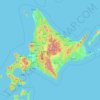
Hokkaido Prefecture
As Japan's coldest region, Hokkaidō has relatively cool summers and icy/snowy winters. Most of the island falls in the humid continental climate zone with Köppen climate classification Dfb (hemiboreal) in most areas but Dfa (hot summer humid continental) in some inland lowlands. The average August…
Average elevation: 81 m

Make a donation


Make a donation
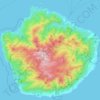
Yakushima
The bedrock of the island is granite, and as such it hosts no active volcanoes. It has an area of approximately 504.5 square kilometres (194.8 sq mi). The island is roughly circular in shape, with a circumference of 89 kilometres (55 mi) and a diameter of 28 kilometres (17 mi). The highest elevations on the…
Average elevation: 401 m


Kanto
The surface geology of the Kantō Plain is the Quaternary alluvium and diluvium. The low mountain vegetation at an altitude of about 500 to 900 m in and around the plain is an evergreen broad-leaved forest zone. The distribution height range of laurel forests is 900 m in Hakone, about 800 m in Tanzawa and…
Average elevation: 29 m
Make a donation